
The First Innings
A Data-Driven Map of Global Assets — and the Asymmetric Opportunity Hiding in Plain Sight

The Sovereignty Brief · Issue #013 · May 2026
There is a question that most investors never think to ask. Not “what should I buy?” — but “how big is everything?”
Before you can understand Bitcoin’s position in the global financial system, you need to understand the system itself. The sheer scale of the asset classes that Bitcoin is now competing with — and the fraction of global wealth it currently represents — reveals something that most market commentary obscures.
We are in the first innings. The data does not suggest it. The data proves it.
The Map of Everything
Every asset in the world can be ranked. Real estate. Debt. Equities. Commodities. Currencies. Cryptocurrency. Here is the current global landscape, sourced from live market data.
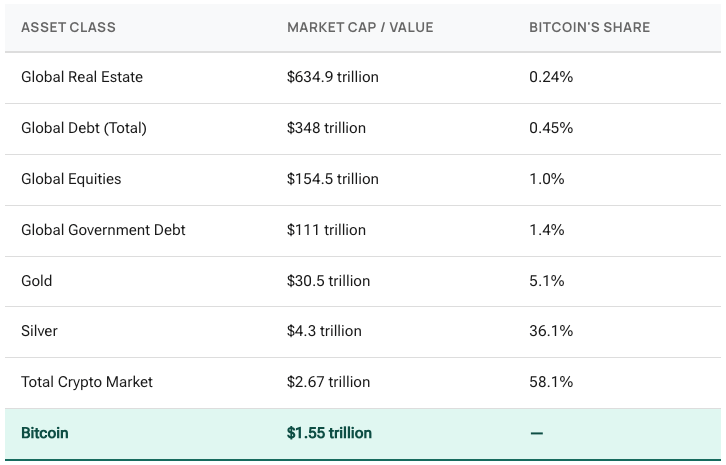
Sources: AssetMarketCap.com (live data, 22 May 2026); IIF Global Debt Monitor (Feb 2026); IMF Global Debt Database; CoinGecko Global Data; Statista World Stock Market; Savills World Research
Read that table again. Bitcoin — the most disruptive monetary technology since the printing press, the only asset with a mathematically fixed supply, the fastest-growing store of value in human history — commands five cents for every dollar held in gold.
It is one percent of global equities. It is less than half a percent of global debt. It is 0.24% of the world’s real estate value.
This is not a mature market. This is a seed that has barely broken the surface.
The Debt Mountain
Global debt reached a record $348 trillion at the end of 2025, according to the Institute of International Finance. That is $29 trillion added in a single year — the fastest build-up since the pandemic surge of 2020. Government debt alone stands at $111 trillion, more than five times the $19.7 trillion recorded in 2000.
$348T Total Global Debt
$29T Added in 2025 Alone
235% Debt-to-GDP Ratio
5.6× Gov Debt Growth Since 2000
The debt-to-GDP ratio sits at 235%, per the IMF’s September 2025 Global Debt Monitor. This is not a temporary condition. It is structural. Governments cannot reduce debt without reducing spending. They will not reduce spending. The political incentive structure guarantees expansion.
Every dollar of this debt represents a claim on future economic output — output that has not yet been produced, by workers who may not yet have been born. Debt is a tax on the future. And the future has already been mortgaged at a rate that no honest accounting can sustain.
Bitcoin’s fixed supply of 21 million coins is the mirror image of this trajectory. Debt expands. Bitcoin does not. Fiat currencies are printed to service the interest on existing debt. Bitcoin’s issuance rate halves every four years and will terminate entirely. One of these systems is mathematically sustainable. The other is a controlled demolition.
The Real Estate Illusion
Global real estate is valued at approximately $634.9 trillion by AssetMarketCap’s inflation-adjusted estimates, making it the single largest store of wealth on earth. Savills World Research places the narrower figure — residential, commercial, and agricultural land — at $393.3 trillion as of early 2025.
Whichever figure you use, real estate dwarfs every other asset class. And that is precisely the problem.
Real estate is not merely an investment. It has been conscripted into service as a monetary instrument — a store of value for people who have no other way to protect their wealth from currency debasement. In Australia, the median house price in Sydney exceeds $1.6 million. That price does not reflect the utility of the dwelling. It reflects the desperation of savers searching for anything that holds value better than the dollar in their bank account.
Real estate is illiquid. It is geographically fixed. It is subject to zoning, council rates, land taxes, stamp duties, and capital gains taxes. It requires maintenance. It depreciates physically. And it is, in most jurisdictions, the single most taxed asset class in existence.
Bitcoin is liquid. It is borderless. It is infinitely divisible. It requires no maintenance. It does not decay. It can be transferred anywhere on earth in ten minutes. And it cannot be taxed at the point of possession — only at the point of conversion.
When $634.9 trillion of real estate exists partly because people have no better store of value, the introduction of a superior one is not a marginal event. It is a tectonic shift.
Global Equities — The Concentration Risk
The world’s stock markets are valued at approximately $154.5 trillion, projected to reach that level in 2026 according to Statista, after hitting a record $147.6 trillion in October 2025.
But look at the composition. From the AssetMarketCap rankings, the top ten companies alone command roughly $30 trillion in market capitalisation. NVIDIA: $5.3 trillion. Alphabet: $4.7 trillion. Apple: $4.5 trillion. These are extraordinary concentrations of value in a handful of entities — each subject to regulation, antitrust action, geopolitical risk, and the strategic decisions of a small number of executives.
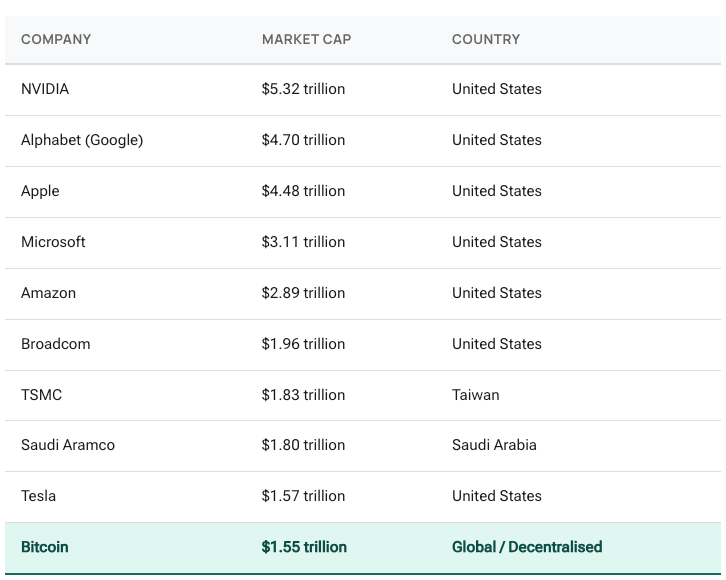
Source: AssetMarketCap.com (live data, 22 May 2026)
Bitcoin sits at the same valuation tier as Tesla. Think about what that means. One is a car company run by a single individual, subject to production targets, consumer sentiment, regulatory approvals, and the performance of an executive team. The other is a decentralised, permissionless, globally distributed monetary network with no CEO, no board, no earnings calls, and no single point of failure.
Bitcoin is ranked 27th among all global assets. It is ahead of Meta. It is ahead of every bank on earth except JPMorgan. It achieved this in fifteen years, with no marketing department, no IPO, and no government backing.
Gold — The Benchmark That Reveals the Asymmetry
Gold’s market capitalisation stands at $30.5 trillion, based on approximately 219,891 tonnes of above-ground stock at a spot price of $4,542 per ounce. For five thousand years, gold has been the benchmark store of value. Civilisations rise and fall. Gold endures.
Bitcoin has existed for fifteen years.
In those fifteen years, Bitcoin has captured 5.1% of gold’s market capitalisation — from zero to $1.55 trillion. It has done so without the institutional infrastructure that supports gold: no central bank reserves, no ETF legacy measured in decades, no jewellery industry, no industrial demand base.
$30.5T Gold Market Cap
$1.55T Bitcoin Market Cap
5.1% BTC as % of Gold
~20× Upside to Gold Parity
Now consider the properties. Gold must be mined, refined, assayed, transported, insured, and stored. Its authenticity must be verified. It cannot be sent electronically. It cannot be divided below a certain physical size without losing verifiability. It is heavy. It is slow. It is analogue.
Bitcoin is mined digitally. Verified cryptographically. Transferred globally in minutes. Divided to eight decimal places. Stored in memory. Verified by anyone with an internet connection. And its supply is not merely scarce — it is mathematically fixed.
If Bitcoin captures even one-third of gold’s store-of-value function, that is a $10 trillion asset — a 6.5× from today. If it reaches parity with gold, that is $30.5 trillion — approximately 20× from current levels.
These are not fantasy projections. They are arithmetic applied to a technology that is doing exactly what its architecture was designed to do.
The Asymmetry
Here is the number that matters most. Bitcoin’s market capitalisation as a percentage of total global wealth — household assets, corporate assets, government reserves, everything — is approximately 0.35%. Total global household wealth alone stands at roughly $470.5 trillion (Credit Suisse Global Wealth Report 2025).
Zero point three five percent.
Approximately 425 million people globally own or have used Bitcoin — roughly 5.3% of the world’s population. That means 94.7% of the planet has not yet participated. Institutional adoption is nascent: sovereign wealth funds are beginning to allocate, but no major pension fund holds Bitcoin as a strategic reserve. Corporate treasuries are still experimenting. Central bank reserves are still denominated in gold and government debt.
1% of Global Wealth
~3×
Bitcoin reaches 1% of $470T global household wealth = $4.7T market cap
Gold Parity
~20×
Bitcoin matches gold’s $30.5T store-of-value market cap
5% of Real Estate SoV
~20×
5% of real estate’s store-of-value premium migrates to Bitcoin
Global Reserve Asset
~50×
Bitcoin adopted alongside gold as sovereign reserve = $75T+
These scenarios are not mutually exclusive. They are overlapping layers of adoption, each reinforcing the next. And none of them require Bitcoin to “replace” anything. They require only that a small fraction of capital currently trapped in inferior stores of value recognises what is available.
The asymmetry is this: your downside is the capital you allocate. Your upside is a 3× to 50× revaluation as Bitcoin transitions from “speculative asset” to “global monetary infrastructure.” That is not a balanced risk profile. That is a generational mispricing.
Where We Are
Consider the trajectory. In 2015, Bitcoin’s market cap was $4 billion. In 2020, it was $500 billion. Today, it is $1.55 trillion. In eleven years, Bitcoin has grown from $4 billion to $1.55 trillion — a 387× increase — while remaining less than half a percent of global wealth.
The internet had 16 million users in 1995. By 2005, it had 1 billion. By 2025, it had 5.5 billion. Bitcoin has approximately 425 million users today. If it follows a comparable adoption curve — and the structural incentives suggest it will, given that every government on earth is actively debasing its currency — then the current market cap is not a ceiling. It is a floor.
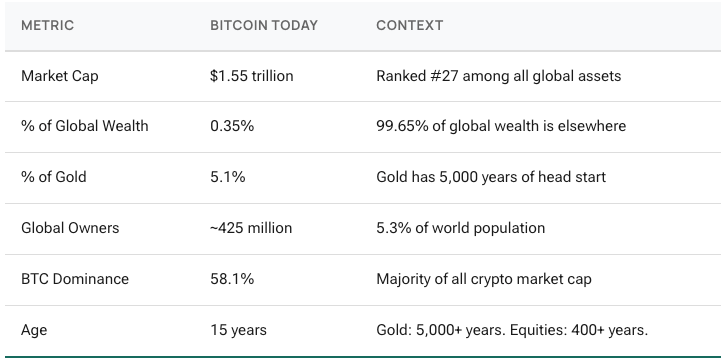
Sources: CoinGecko Global Data; Investopedia Global Wealth Analysis; AssetMarketCap.com; Coinranking Adoption Data
This is the first innings. Not the third. Not the fifth. The first. The batsman has walked to the crease, taken guard, and played the first over. The scoreboard reads 5.1% of gold. 0.35% of global wealth. 5.3% of the world’s population.
Anyone who tells you it is “too late” to buy Bitcoin is telling you that an asset representing one-third of one percent of global wealth has already reached its terminal value. That is not analysis. It is intellectual laziness.
The Position
The data is not ambiguous.
Global debt is $348 trillion and accelerating. Real estate is $635 trillion and being used as a monetary instrument by people with no alternative. Equities are $154 trillion and concentrated in a handful of US technology companies. Gold is $30.5 trillion and analogue. The foreign exchange market processes $9.6 trillion per day in bets on relative debasement.
Bitcoin is $1.55 trillion. It is fifteen years old. It is owned by 5.3% of the world. It cannot be debased. It cannot be seized in self-custody. It cannot be counterfeited. It cannot be shut down. And the world’s largest financial institutions are now building tokenised infrastructure on top of the technology it pioneered.
The question is not whether Bitcoin will grow from here. The mathematics of adoption, the structural deterioration of fiat alternatives, and the tokenisation megatrend all point in one direction. The question is whether you will be positioned for it — or whether you will spend the next decade watching from the stands while the first innings unfolds into the second, the third, and beyond.
Action Steps
Study the map. Understand the relative size of every asset class. Bitcoin at 0.35% of global wealth is not a mature allocation — it is a rounding error. The asymmetry is real and it is quantifiable.
Understand the debt spiral. $348 trillion in global debt is not a number that resolves through austerity. It resolves through debasement — the silent destruction of currency purchasing power. Bitcoin is the exit.
Compare Bitcoin to gold honestly. 5.1% of gold’s market cap after 15 years vs. gold’s 5,000-year head start. The trajectory is not speculative. It is directional.
Size your position against the opportunity. A 1–5% allocation to Bitcoin is not a speculative bet. It is a hedge against a fiat system that is mathematically unsustainable, and an option on a 3× to 50× revaluation as adoption moves from 5% to 50% of the global population.
Talk to someone who understands the data. Not the narrative. Not the hype. The data. If you want to understand how to position against the largest asymmetric opportunity in modern financial history, we will give you a direct answer.
⭐ remarkably important pure analysis & detail of the precise current valuation of bitcoin versus selected significant markets...